I love the idea of associating symbols with our albums. It helps guide the aesthetic of a campaign and allows us to create a sense of nostalgia with our audience. My father was a sextant navigator for the trans-Atlantic shipping industry during the 1970s. GPS did not exist then, and every ship traveling the world relied on a trained celestial navigator, looking to the stars for guidance. Before 9/11, it was possible to work aboard a ship and, once it reached its destination, step off and explore for a while. When it was time to return, another vessel heading back to the States was always nearby, in need of a guiding hand home.
During his travels, my father carried a small transistor radio with him to listen to music. He gave me this radio a few years ago, and until about six months ago it was a beautiful but silent mantle piece. When trying to come up with a symbol for our new album, something about the design and history of that radio appealed to me. It encompassed everything I feel Little Tybee represents, while also commenting on the state of the music industry today. Transistor radios were the first truly portable music listening devices. Before the transistor, vacuum tubes were the standard. They were heavy, bulky, and required time to warm up before producing sound. The transistor radio paved the way for the Walkman, the CD player, and eventually the digital music players we use today.
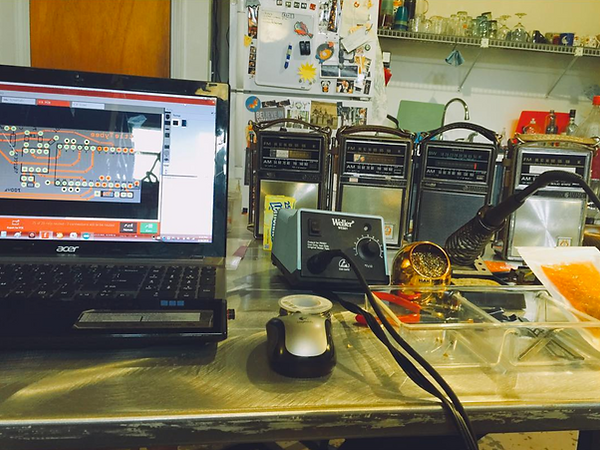
I imagine how exhilarating it must have been to hear a song for the first time while traveling through an unfamiliar place. We take that experience for granted now, but I feel a strong connection to the sense of wonder early owners of these radios must have felt. I wanted to capture that feeling and pair it with our music. I work in the film industry in Atlanta, building movie props, and I have a business partner, Myron Lo, who is a talented electrical engineer. Together, we came up with the idea to retrofit the radio with modern electronics so it could play music through a standard input. We also added a band of LEDs that would light up in response to the sound coming through the radio.
The idea was to film the radio in different locations while playing each song from our new album through it. When albums are released today, fans often upload tracks to YouTube paired with a static image of the album cover. Traditional music videos are time-consuming and expensive to produce, often requiring significant resources. Instead, we decided to create an evolving visualizer for the record by inviting our audience to help generate the imagery. Last September, I traveled to Spain to bike the Camino de Santiago with a friend. I brought the first prototype radio with me and filmed it in twelve locations along the route while playing each song from the album. The footage turned out beautifully, and I initially thought that would be the end of the project.
Soon after, that same friend offered to take the radio to Southeast Asia and film with it there. That was the moment I realized the project could become much larger than I had imagined. I went on eBay and purchased as many similar radios as I could find, then hired Myron to outfit each one with the same electronics. I began reaching out to videographers around the world and have been mailing these radios to new locations every few weeks ever since. So far, radios have traveled to Portugal, Panama, Iceland, Scotland, Greece, Brazil, Japan, Ireland, China, and various locations throughout the United States.
By the end of the project, I plan to have more than 400 videos. I will release a new video every day or so over the course of three months, and once all the footage is collected, I will edit everything together into a single, long-form visualizer for the entire album, approximately fifty minutes in length. I plan to submit the completed piece to film festivals during the 2017 circuit. This project is a collaboration with the world, shaped by how people interact with the objects that bring joy into their lives.
I believe that everyone is an artist. Sometimes they just need an old General Electric radio to bring it out of them.